
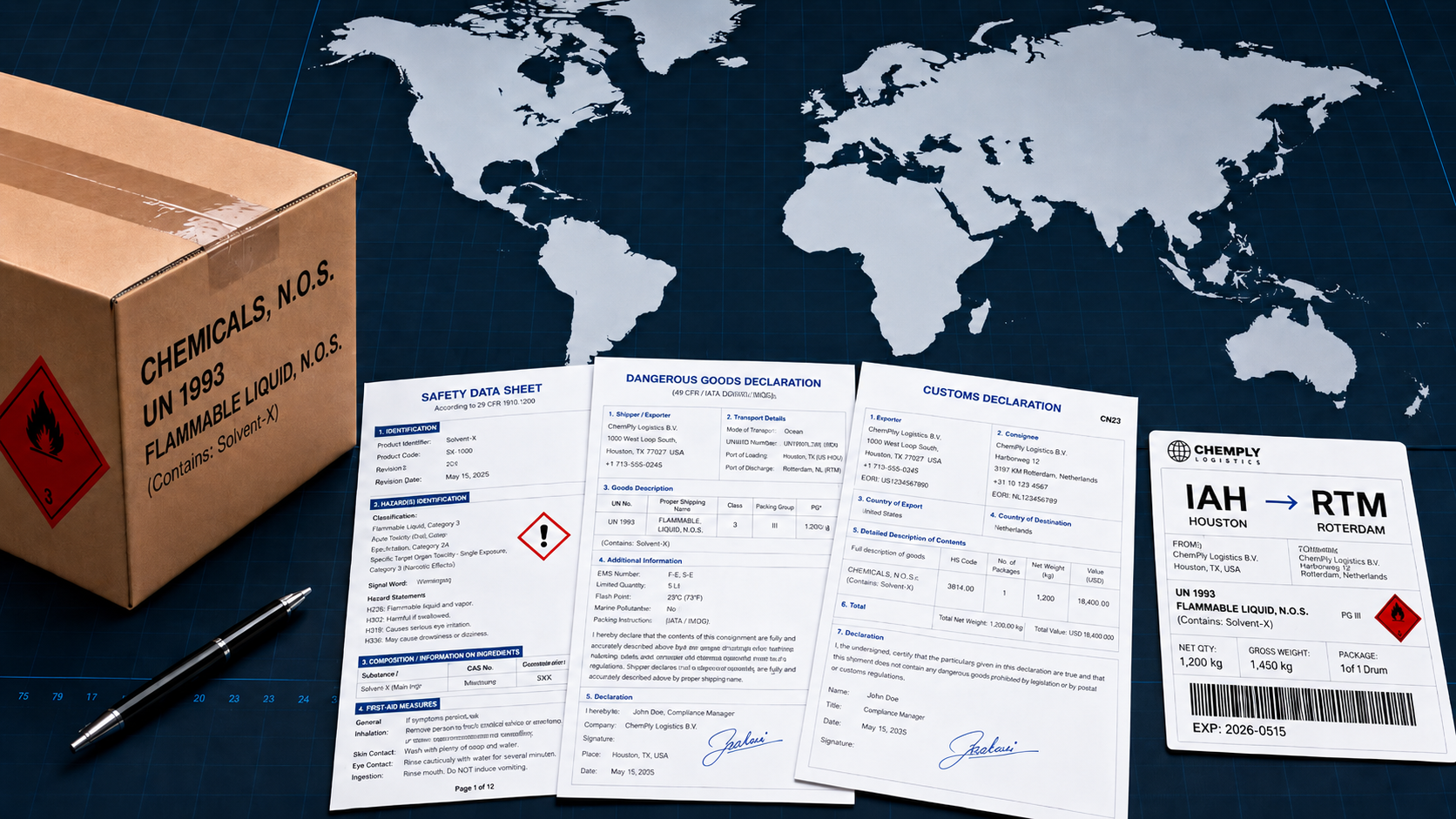
Getting ready to ship a chemical product internationally is where a good SDS can still fail you. Not because the SDS is badly written, but because it is only one part of the compliance package. The same product may need a destination-compliant SDS, a transport classification under the applicable modal rule, a dangerous goods declaration or shipping paper, carrier-acceptable emergency response information, transport labels and marks, and language and format choices that match the receiving market. The risk is assuming those pieces reconcile automatically. They often do not.
International shipment of a substance or mixture sits at the intersection of two regulatory systems: hazard communication and transport of dangerous goods. Getting a product across a border legally means satisfying both, separately, while also accounting for the destination market and the carrier's own acceptance requirements.
Shipping chemicals internationally may require a destination-compliant SDS, a separate dangerous-goods classification, shipping papers or declarations, transport marks and labels, emergency-response information, customs records, and carrier-specific documentation. The exact packet depends on the product, origin, destination, transport mode, package, quantity, and the carrier accepting the shipment.
01 - ChecklistWhat documents are required to ship chemicals internationally?
There is no universal document packet, but a regulated shipment commonly requires the following records. Confirm the current modal and carrier rules before tendering the package.
- A destination-compliant safety data sheet in the required language and format.
- A current transport classification, including the UN number, proper shipping name, class or division, and packing group where assigned.
- The applicable dangerous-goods declaration or shipping paper for air, sea, road, or rail.
- Required package marks, transport labels, and any marine-pollutant, limited-quantity, or orientation marks.
- Emergency-response information and a 24-hour contact number when the governing transport rule requires them.
- Commercial, customs, carrier, and product-specific permits or certificates required for the route.
Download the international chemical shipping checklist
To help you keep track of these requirements when shipping chemicals internationally, use our free, fillable checklist as a quick reference for each consignment. Record shipment details, SDS and transport document references, completed or not-applicable checks, outstanding items, and sign-offs. Print it, or fill it out in your browser or PDF editor, then save a copy with your shipping records.
Is an SDS required for international shipping?
An SDS is a hazard-communication document, not the transport document of record. Still, destination law may require a compliant SDS when the product is placed on that market, and a carrier or operator may require an SDS as a condition of acceptance. Treat those duties separately from the dangerous-goods declaration.
What does SDS Section 14 contain?
Section 14 summarizes transport information such as the UN number, proper shipping name, transport hazard class, packing group, environmental hazards, bulk-transport information, and special precautions. Our SDS Section 14 transport information guide explains each field and shows how UN 3077 and UN 1993 work as examples.
Does Section 14 replace a dangerous-goods declaration?
No. Section 14 is a summary inside the SDS. The shipping paper or declaration is prepared for the actual consignment under the applicable modal rule and may require quantity, packaging, technical names, authorizations, and certification that Section 14 does not supply.
Does an SDS have to be attached to a chemical shipment?
Not as a universal substitute for the shipping paper. Whether an SDS must accompany or be provided with a shipment depends on the destination's hazard-communication rules and the carrier or operator's acceptance requirements. Keep the SDS and the dangerous-goods transport documents separate, and verify both before tendering the shipment.
Can you ship a chemical internationally with an old SDS?
Use a current, accurate SDS that complies with the receiving market. Age alone does not decide validity, but an SDS that omits new hazard information, uses a superseded classification, has the wrong language or format, or conflicts with the current product and transport determination should not be used for the shipment.
What if two SDSs list different UN numbers?
Do not choose a UN number based on the SDS language or country name alone. Resolve the current transport classification for the actual product, formulation, package, mode, and route, then correct the inconsistent SDS. The shipping paper or declaration must use the description required for that consignment.
Which country's SDS rules apply?
Build the SDS for the market where the chemical is supplied. The receiving jurisdiction controls required language, format, classification, and local content; the origin-country SDS does not automatically remain compliant after the product crosses a border.
02 - SystemsTwo systems, not one
The first system is hazard communication. Its job is to tell a worker or downstream user what a chemical is and how to handle it across its whole working life: storage, processing, spill response, disposal. Its document is the safety data sheet. In the United States this lives in OSHA's Hazard Communication Standard, 29 CFR 1910.1200, with the 16-section SDS format fixed in mandatory Appendix D. In the EU it lives in REACH Article 31 and Annex II, with classification criteria supplied by the CLP Regulation (EC) No 1272/2008. Both descend from the UN GHS, but each is its own legal instrument and neither adopts GHS by reference.
The second system is transport of dangerous goods. Its job is narrower and more acute: keep a package from causing an incident while it is moving, sitting in a cargo hold, or stacked in a container. Its source text is the UN Recommendations on the Transport of Dangerous Goods, the Model Regulations, the "Orange Book." That model is then implemented mode by mode: the ICAO Technical Instructions and their commercial expression, the IATA Dangerous Goods Regulations, for air; the IMDG Code (IMO) for sea; ADR for road in Europe; and 49 CFR Subchapter C, the Hazardous Materials Regulations enforced by PHMSA, for US ground. The transport system classifies goods into nine transport classes, assigns packing groups I to III, and identifies each substance by a UN number and a proper shipping name. Its controlling documents are the dangerous goods declaration, the shipper's declaration, and the shipping papers.
These are different classifications produced for different reasons, and they do not map one-to-one.
A good SDS is only one part of the international shipping compliance package.
03 - BoundaryWhere the two systems touch, and where they part
The visible bridge between them is SDS Section 14, Transport Information. It carries the UN number, proper shipping name, transport hazard class, packing group, and marine pollutant status. The trap is to read Section 14 as the transport classification of record. Section 14 is a summary of a determination made under the transport rules. The shipping paper and the shipper's declaration are the operative transport documents. If the formulation changes, or the transport rules update on their roughly two-year cycle, Section 14 can lag the actual carriage requirement, and the declaration is what governs at the dock.
The deeper divergence is that the hazard class in Section 2 of the SDS is not the transport class in Section 14. The cleanest illustration sits in flammable liquids, and it lands squarely on heavier petroleum products: base oils, many metalworking fluids, fuel oils. Consider a closed-cup flash point of 75 °C.
Under GHS, and under OSHA HazCom Appendix B.6, flammable liquids are split into four categories by flash point and initial boiling point. Under the UN Model Regulations, Class 3 stops at a flash point of 60 °C and is subdivided into three packing groups. Under EU CLP, Annex I section 2.6 reproduces only Categories 1 to 3.
| Flash point band (closed cup) | GHS / OSHA HazCom category | EU CLP | Transport (UN Class 3) |
|---|---|---|---|
| FP < 23 °C, initial BP ≤ 35 °C | Category 1 | Category 1 | Packing Group I |
| FP < 23 °C, initial BP > 35 °C | Category 2 | Category 2 | Packing Group II |
| FP ≥ 23 °C and ≤ 60 °C | Category 3 | Category 3 | Packing Group III |
| FP > 60 °C and ≤ 93 °C | Category 4 | Not classified as flammable | Not Class 3 |
So the 75 °C base oil is, on a US SDS, a flammable combustible liquid: Category 4, hazard statement H227 "Combustible liquid," signal word "Warning," and no pictogram. On an EU SDS for the same product, it carries no flammability classification at all, because CLP has no Category 4. And in Section 14, for flammability purposes it is not regulated for transport, because Class 3 ends at 60 °C absent carriage at elevated temperature, which is a separate trigger. One drum, three different answers to "is this flammable," each correct within its own regime.
The DOT transport diamond does not collapse the systems. OSHA's shipped-container allowance for dropping the corresponding HazCom pictogram is a label-allocation rule, not a statement that transport and HazCom classifications are equivalent.
There is a second, narrower bridge worth knowing, because it is the one practitioners most often over-apply. Under 29 CFR 1910.1200(f)(5)(iii) and the parallel instruction in Appendix C, where a DOT transport pictogram appears on a shipped container, the corresponding HazCom pictogram for the same hazard is not required on the label. After the 2024 HazCom final rule it is permitted but not mandatory. This is a label-allocation rule for the container, not a statement that the two classifications are equivalent. The transport diamond and the HazCom red-border square communicate to different audiences under different criteria, and the allowance to drop the redundant square does not collapse the two systems into one.
04 - RationaleWhy the boundaries sit where they do
The flash-point divergence is not an oversight; it reflects what each system is trying to prevent. Transport regulation is concerned with the acute incident risk of a package in motion, the pool fire in a cargo hold or an overturned trailer. A liquid that will not throw an ignitable vapour below 60 °C is treated as not posing that acute carriage risk, so it falls out of Class 3. Hazard communication is concerned with the full working lifecycle, including a drum heated for processing or held in a hot plant in summer. A liquid that becomes a fire risk when warmed toward 75 or 90 °C still needs to be communicated to the worker who will warm it, which is why the hazcom regimes that adopt Category 4 keep it on the SDS. The UN building-block model is what makes this legal divergence possible: jurisdictions choose which categories to adopt, and the US adopted the flammable Category 4 band that the EU and the transport rules do not.
05 - DestinationThe SDS itself is governed by the destination, not the origin
The second failure mode in the opening, the French-language rejection, is a jurisdiction problem, and it is independent of transport entirely. When you place a product on a foreign market, the receiving jurisdiction's hazard communication regime governs the SDS. The origin country's rules do not travel with the goods.
For the United States, the controlling text is 29 CFR 1910.1200(g), with the section content in Appendix D. The standard requires the SDS to be in English (the employer may keep additional-language copies), and it requires all 16 sections in order even though OSHA has stated it will not enforce the information requirements in Sections 12 through 15, which include the transport section, because those fall outside its jurisdiction. Sections must still appear; a sub-heading with no data must be marked as such rather than left blank.
Build the SDS to the receiving market. Origin-country hazard communication rules do not travel with the shipment into a foreign market.
For the EU the requirements are heavier and the language rule is the one that catches exporters. Since the transition period under Commission Regulation (EU) 2020/878 closed at the end of 2022, every SDS circulating in the EU must follow the amended Annex II format. REACH Article 31(5) requires the SDS to be supplied in an official language of each Member State where the product is placed on the market, unless that Member State provides otherwise. A single English SDS shipped into France, Germany, Italy, and Spain is non-compliant in at least three of those four markets, and it is the recipient Member State, not the country of manufacture, that decides whether any exemption applies.
On top of language, the 2020/878 format pulled in obligations that do not exist on a US sheet: the Unique Formula Identifier (UFI) must appear in Section 1 for mixtures that require it, tied to the poison-centre notification system established by Annex VIII to CLP (Regulation (EU) 2017/542); and EU-only hazard classes must be flagged where they apply, including endocrine disruptors and the PBT, vPvB, PMT, and vPvM designations added by Delegated Regulation (EU) 2023/707. Those classes are neither UN GHS nor OSHA hazards. A class appearing on a European SDS does not make it a GHS class, and it has no home on a US sheet.
Other destinations add their own constraints. Great Britain runs its own GB CLP and UK REACH regimes post-Brexit, with the SDS in English. Canada's Hazardous Products Regulations require the SDS in both English and French. The substantive WHMIS classification mechanics are their own body of law and are outside what this post verifies. The through-line is the same everywhere: build the SDS to the destination, not to the shipping origin.
There is also a version-skew problem layered on top. The US 2024 HazCom final rule (89 FR 44144, published 20 May 2024, effective 19 July 2024) aligned OSHA primarily with GHS Revision 7, with the transition phased in over the following years. The EU and the current UN text sit ahead of that. The same product can therefore carry genuinely different classifications on its US and EU sheets at the same moment, not because one is wrong, but because the two regimes are anchored to different GHS revisions.
06 - PracticeCarrier reality and the mistakes that recur
Carrier practice adds a layer beyond the legal transport document set. Carriers and freight forwarders routinely require an SDS as a condition of carriage, and numerous IATA operator and state variations explicitly require an SDS, in English, to accompany a dangerous goods consignment. In practice you need both: a correct dangerous goods declaration prepared under the relevant modal rules, and an SDS the carrier will accept.
There is no single universal document packet for every dangerous goods shipment, because the answer depends on the product, origin, destination, mode, carrier, and any customs or controlled-substance rules layered on top. But for an international shipment of regulated dangerous goods, the working file normally includes:
- the transport document required for the leg: an IATA shipper's declaration for air, an IMDG dangerous goods declaration for sea, an ADR transport document for European road, or the 49 CFR shipping paper for US ground;
- the basic dangerous goods description: UN number, proper shipping name, transport hazard class or division, subsidiary risk where required, packing group where assigned, quantity, number and type of packages, and any required technical name, marine pollutant, limited quantity, or other special entry;
- emergency response information and a 24-hour emergency telephone number where the applicable transport rule requires it;
- a destination-compliant SDS in the required format and language, plus any carrier-required English SDS copy;
- commercial and customs documents, typically a commercial invoice, packing list, bill of lading or air waybill, and any required export or import declarations;
- permits, licenses, certificates, or manifests where the product triggers additional controls, such as hazardous waste, precursors, pesticides, dual-use controls, temperature-controlled materials, or country-specific restricted chemicals.
The recurring errors cluster predictably. Treating Section 14 as the classification of record, when the declaration governs and Section 14 can lag. Assuming the GHS hazard class equals the transport class, when the 75 °C base oil shows exactly why it does not. Shipping one global SDS into every market, which fails on language and on jurisdiction-specific content at the same time. Assuming "not regulated for transport" means "not hazardous," when a Category 4 combustible liquid is not a transport dangerous good yet is still a communicated hazard, and assuming the reverse, when a substance can be an environmentally hazardous substance for transport (UN 3077 solid, UN 3082 liquid, the marine pollutant designation) under criteria that do not line up with the GHS aquatic classification on the SDS.
Emergency-contact fields are another common source of false equivalence. The 24-hour response number a carrier wants on the shipping paper, the CHEMTREC line many US manufacturers use, and the EU SDS Section 1.4 emergency-contact expectation are separate requirements with separate rules, not one field reused three times.
07 - DecisionsDecision rules
Run the GHS hazard classification for the SDS and the transport classification for carriage as two separate determinations, and never derive one from the other. Section 14 is an output of the transport determination, not a substitute for it.
Match format, content, and language to the receiving jurisdiction: Appendix D and English for the US; Annex II per 2020/878, the official language of each Member State per Article 31(5), and UFI plus EU-only hazard flags for the EU.
That band can be an OSHA Category 4 combustible liquid on a US sheet, unclassified for flammability in the EU, and outside transport Class 3. All three outcomes can be correct.
Use IATA DGR for air, IMDG for sea, ADR for road in Europe, and 49 CFR for US ground. Also have a carrier-acceptable SDS in hand, because many carriers and operator or state variations require one even though it is not the transport document.
The shipping-paper 24-hour number, the US SDS Section 1 contact, and the EU SDS Section 1.4 contact are separate obligations; populate each to its own rule.
The US sitting at Revision 7 while the EU and UN are ahead means the same product can legitimately classify differently on two sheets at once; treat that as expected, not as an error to reconcile.
Continue the workflow with the dedicated SDS Section 14 transport information guide, the OSHA SDS Section 2 requirements, and the GHS pictogram guide for SDSs and labels.
Written by the Chemply Regulatory Team. Citations refer to OSHA HazCom, REACH and CLP, UN Model Regulations, IATA DGR, IMDG, ADR, 49 CFR hazardous materials rules, and destination-market SDS requirements discussed above.
This is general regulatory information, not legal advice, and it is not a substitute for professional regulatory judgment on a specific product.