
The substance compliance date under OSHA’s revised Hazard Communication Standard passed on May 19, 2026. A formulator may nevertheless still hold an ingredient SDS prepared before that date. The preparation date alone does not establish whether the SDS complies with HCS 2024 or contains the information needed to classify the formulator’s mixture. If needed information is missing, the natural response is to ask the supplier for it. The harder question begins when the supplier does not respond.
If an employer receives a hazardous chemical without an SDS, it should promptly request the SDS from the supplier and document the request. The employer should not invent its own supplier SDS. Separate classification and authoring duties may apply when the company is itself a manufacturer, importer, or distributor.
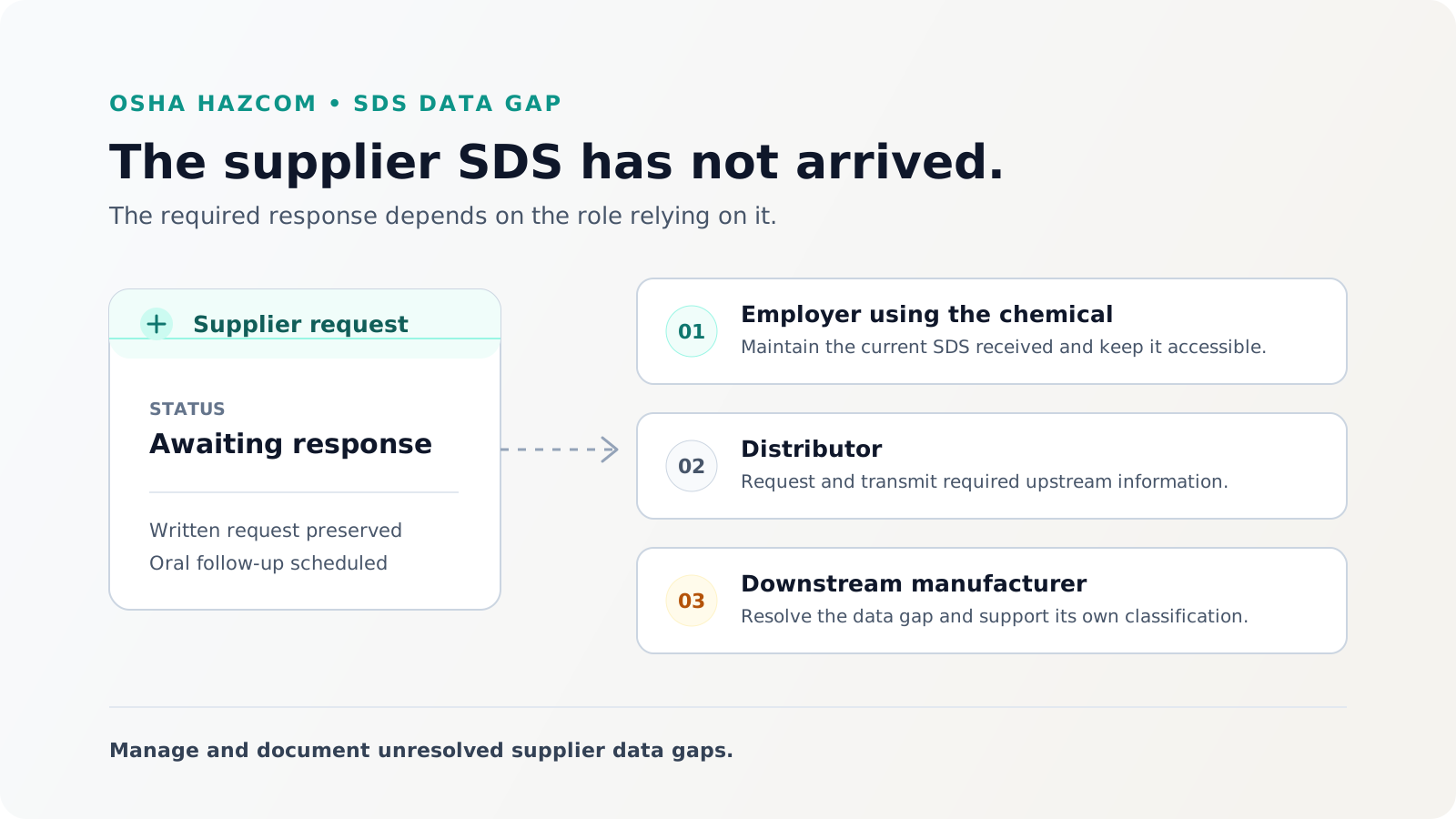
There is no single HazCom answer that applies to every company waiting on a document. An employer maintaining SDSs for chemicals used in its workplace has a different obligation from a distributor transmitting supplier documents, and both are in a different position from a manufacturer using ingredient data to classify a downstream mixture.
A document can be the most recent SDS you received and still be inadequate for the work you are trying to perform.
For an employer, maintaining that document may be compliant. For a formulator preparing its own SDS, relying on the same document without further investigation may not be.
This is the operational companion to our earlier analysis, The HazCom Transition Window Is Closing One Gate at a Time, which explains why the substance and mixture deadlines do not arrive together.
01 - RolesWhat should each role do when a supplier has not provided an SDS?
The first step is to identify which legal role your company occupies for the chemical in question.
| Your role | Immediate HazCom duty | Responsibility for SDS accuracy |
|---|---|---|
| Employer using the chemical | Maintain the required SDS and make it immediately accessible to employees | Generally not responsible for supplier content unless the employer changes the SDS |
| Distributor | Transmit SDSs and updated information to downstream distributors and employers | May rely in good faith on the manufacturer’s SDS unless it changes the document or substitutes itself as the responsible party |
| Manufacturer or importer of a downstream product | Classify its product and prepare an accurate SDS for each hazardous chemical it produces or imports | Remains responsible for its own classification and SDS, even when using supplier or third-party information |
Role follows the activity, not the company’s title. For example, a business that blends, mixes, or repackages chemicals may be acting as a chemical manufacturer under the HCS rather than solely as a distributor. (29 CFR 1910.1200(c), (d)(1), and (g)(1))
The distinction matters because “we have not received an update” can describe three different problems:
- An employer has an older SDS in its workplace files.
- A distributor has not received the document it must transmit downstream.
- A formulator lacks ingredient data needed to support the classification of its own product.
OSHA does not treat those situations as equivalent. (OSHA HCS 2024 enforcement directive, X.G)
02 - DistributionOSHA does not require every customer to receive an update on the day it is prepared
Under 29 CFR 1910.1200(g)(6)(i), a chemical manufacturer or importer must provide an appropriate SDS with the initial shipment and with the first shipment after the SDS is updated. The SDS must also be supplied upon request under (g)(6)(iv). Distributors have corresponding transmission duties under (g)(7). The standard does not establish a blanket requirement to resend every revised SDS immediately to every customer that has ever purchased the product. (29 CFR 1910.1200(g)(6)-(7))
A request creates a separate obligation. Manufacturers and importers must provide the SDS to distributors or employers upon request under (g)(6)(iv). Wholesale distributors must also provide SDSs upon request, while the standard contains more specific request rules for retail and over-the-counter sales under (g)(7)(iii)-(vi). If a shipment labeled as a hazardous chemical arrives and the required SDS has not been provided, the distributor or employer must obtain one from the manufacturer or importer as soon as possible under (g)(6)(iii).
The age of a workplace SDS, by itself, does not prove a violation. OSHA’s 2026 enforcement directive says an employer may remain compliant while maintaining an older MSDS or HCS 2012 SDS for a product it has not recently received, even after the final employer transition date. That is not permission to ignore a later shipment: retaining the prior version is not compliant if the employer ordered the chemical after the manufacturer updated the SDS and the required current document was not obtained. Once an HCS 2024 SDS is received, the employer must maintain it as the current SDS; an older version may still need to be retained as an employee-exposure record under 29 CFR 1910.1020. (OSHA directive, X.G.4 and X.G.6)
- Maintain the most recent SDS received; a product not recently reordered may legitimately retain an older current copy.
- Ensure employees have immediate access to it.
- Request an SDS promptly if a shipment labeled as hazardous arrives and the required SDS was not provided.
- Make a newer SDS the current workplace copy while preserving older records when 29 CFR 1910.1020 requires it.
The employer does not ordinarily become responsible for independently correcting the supplier’s classification simply because the document is old. OSHA states that employers assume no responsibility for the content and accuracy of an SDS supplied to them unless they change it. (OSHA directive, X.G.4)
03 - ClassificationA formulator relying on the SDS has a different problem
A downstream manufacturer cannot stop its analysis at “this is the latest document the supplier sent.”
When classifying a mixture, 29 CFR 1910.1200(d)(3)(ii) permits a manufacturer or importer to rely on the current SDSs for the individual ingredients. That permission ends where the company knows, or in the exercise of reasonable diligence should know, that an ingredient SDS misstates or omits information required by the standard. (29 CFR 1910.1200(d)(3)(ii))
The phrase “should know” is the pressure point. A formulator does not have to retest every raw material or assume that every supplier document is wrong. It also cannot ignore an obvious data gap merely because the supplier has not issued a revision.
Examples that should trigger further review include:
- A substance SDS still appears to use superseded classification criteria after the substance compliance date.
- Section 2 conflicts with toxicological or physical-property data elsewhere in the document.
- The SDS omits information needed to distinguish inhalation gases, vapors, or dusts and mists.
- The classification conflicts with an authoritative regulatory classification or with reliable data already in the formulator’s possession.
- The supplier has acknowledged that an update is underway but has not provided the revised classification.
- Different SDSs from the same supplier provide materially different classifications for the same product, composition, and physical form.
The downstream manufacturer also has an independent duty under §1910.1200(g)(5) to ensure that its own SDS accurately reflects the scientific evidence used in its hazard classification. Purchasing an SDS, importing data from a database, or copying another document does not transfer that responsibility to the source. OSHA’s enforcement directive specifically states that manufacturers and importers using purchased SDSs, internet sources, or other SDSs retain responsibility for downstream communication and for the accuracy of their own documents. (OSHA directive, X.G.2)
04 - DeadlinesThe current transition calendar changes the urgency
As of July 2026, manufacturers, importers, and distributors evaluating substances must comply with the modified HCS 2024 provisions. That deadline passed on May 19, 2026. (OSHA compliance-date extension)
The downstream mixture deadline is later. Manufacturers, importers, and distributors evaluating mixtures must comply with the modified provisions by November 19, 2027. Employers then have until May 19, 2028 to make any necessary mixture-related changes to workplace labeling, their written hazard communication programs, and employee training. (29 CFR 1910.1200(j))
| Obligation | Current deadline |
|---|---|
| Manufacturer, importer, or distributor evaluating a substance | May 19, 2026 |
| Employer workplace updates related to substances | November 20, 2026 |
| Manufacturer, importer, or distributor evaluating a mixture | November 19, 2027 |
| Employer workplace updates related to mixtures | May 19, 2028 |
The later mixture deadline gives formulators time to integrate revised upstream substance information, but it does not make missing supplier data irrelevant until 2027. In the HCS 2024 preamble, OSHA considered concerns that downstream manufacturers may not receive key upstream information in time and retained separate substance and mixture tiers while modestly extending the proposed schedules. A formulator waiting until the final months of the mixture transition to identify missing ingredient classifications may have little time left to obtain the data, perform the classification, review the results, and revise its SDSs and labels. (HCS 2024 final-rule preamble)
The transition provision also does not suspend §1910.1200(g)(5). A chemical manufacturer, importer, or employer preparing an SDS must add newly discovered significant hazard or protective-measure information within three months. If the chemical is not currently produced or imported, the information must be added before the chemical is introduced into the workplace again. Under §1910.1200(f)(11), a manufacturer, importer, distributor, or employer newly aware of significant hazard information generally must revise the label within six months. HCS 2024 includes a specific accommodation for containers already released for shipment, and a chemical not currently produced or imported must be relabeled before it is shipped or reintroduced. These update rules operate independently of the HCS 2024 system-conversion dates. (29 CFR 1910.1200(f)(11) and (g)(5))
05 - EvidenceThe directive’s transition-specific diligence and good-faith policy
OSHA’s 2026 enforcement directive contains a transition-specific enforcement policy. When a manufacturer, importer, or distributor asserts that circumstances beyond its control prevented it from meeting an applicable HCS 2024 compliance date, compliance officers evaluate its reasonable-diligence and good-faith efforts case by case. This policy does not define the separate “reasonable diligence should know” standard in §1910.1200(d)(3)(ii), and satisfying its factors is not a general safe harbor for an inaccurate mixture classification. (OSHA directive, X.J.3-X.J.7)
In that missed-deadline setting, OSHA instructs inspectors to review the entity’s overall efforts and may request documentation of attempts to:
- Obtain classification information and SDSs from upstream suppliers
- Find hazard information from alternative sources, such as chemical registries
- Classify the available data internally
The directive does not say that sending one email automatically satisfies the test. Inspectors are instructed to review the entity’s overall efforts, their timing, and the actions taken to integrate information needed for compliance.
For manufacturers and importers seeking consideration under this policy, the directive requires attempts to obtain necessary classification information or SDSs through both oral and written communications with the upstream supplier. Its detailed documentation factors are written specifically for manufacturers and importers; the distributor provisions focus particularly on documenting communications with the manufacturer or importer. The table separates OSHA’s stated factors from Chemply’s practical recordkeeping suggestions.
| Evidence category | OSHA factor and practical detail |
|---|---|
| Supplier outreach | OSHA: oral and written attempts, including dated written communications. Practical detail: contacts, product identifiers, requests, responses, and follow-ups. |
| Internal process | OSHA: the documented process used to gather upstream classification information and the current status of those efforts. |
| Alternative research | OSHA: documented efforts to find hazard information from alternative sources. Practical detail: sources, versions, retrieval dates, and results. |
| Internal classification | OSHA: attempts to classify available data. Practical detail: criteria, selected data, assumptions, calculations, and unresolved limitations. |
| Distributor communication | OSHA, for manufacturers and importers: dated written communications telling distributors why HCS 2024 compliance is delayed. |
| Remediation plan | OSHA: a course of action once information becomes available and a clear expected compliance timeline. Practical detail: owners and review dates. |
Within this transition-specific analysis, any combination of the listed efforts may support a finding of reasonable diligence and good faith, but inspectors evaluate all relevant factors. They also consider whether efforts began promptly and whether the manufacturer or importer can provide a clear expected compliance timeline. (OSHA directive, X.J.7)
Treat supplier silence as a managed and documented data gap. This is operational guidance, not a separate OSHA recordkeeping mandate for every unanswered request.
06 - RequestsA request for “the updated SDS” is often too vague
A generic request may produce a revised PDF without resolving the classification problem. The request should identify the information actually needed.
Depending on the ingredient, a practical request may include the items below. Not every item is independently required on an ingredient SDS, and applicable trade-secret provisions may limit exact composition information. This is a request checklist, not a claim that the HCS compels disclosure of every item. (29 CFR 1910.1200 Appendix D)
- The HCS version used for classification
- Hazard classes and categories, not only H-statements
- Specific concentration limits or other classification thresholds
- Acute toxicity estimates separated by route and physical form
- The basis for an acute toxicity estimate
- Flash point and test method
- Initial boiling point
- Physical state and form
- Particle characteristics where relevant
- Whether the substance can become more hazardous through a known downstream use
- The effective date and revision history of the classification
This distinction is important because an H-code alone is often insufficient to classify a mixture. A formulator may need the underlying category, test result, route-specific value, concentration threshold, or physical-property measurement. Receiving another PDF that repeats the same incomplete information does not cure the gap.
A targeted request can strengthen the company’s classification record and, where applicable, evidence under the directive’s missed-transition-deadline analysis. It can show that the downstream company identified the missing input, communicated it to the supplier, and understood why the information mattered.
Supplier SDS request email template
Replace the bracketed fields and identify the specific gap. Requesting supporting data does not override applicable trade-secret protections or mean every requested item is independently required on the SDS.
Subject: Current SDS and clarification request — [product name / product code]
Hello [supplier contact],
Please send the current SDS for [product name and code], supplied to [company] for use in [destination market], in [required language]. Our copy is dated [revision date / no SDS received].
We need clarification on [specific missing or conflicting information] to support [workplace review / downstream classification / another stated purpose]. Please confirm whether our copy is current and identify any changes relevant to this request, including the classification basis where available.
If the requested SDS or clarification is not yet available, please confirm the appropriate technical contact and expected response date. If information cannot be disclosed, please let us know what supporting information can be provided.
Our requested follow-up date is [date]. This is our planning date, not a statement of a statutory response deadline.
Thank you,
[name, role, company, contact details]
Download the supplier follow-up log (CSV) to record the request, response, remaining gaps, owner, and next review date. Receipt of a new SDS closes the request only after the relevant information has been checked.
07 - ResearchAlternative sources can support the investigation, but they do not automatically replace the supplier SDS
In its missed-transition-deadline analysis, OSHA’s directive recognizes searches of alternative sources, including chemical registries, as possible evidence of diligence. Separately, §1910.1200(d)(2) requires a classifier to consider the full range of available scientific literature and other evidence. Neither rule means the first database result should be copied into an SDS. (OSHA hazard-classification guidance)
Alternative records can differ because they:
- Apply another jurisdiction’s classification system
- Use a different GHS revision
- Reflect a harmonized classification rather than the supplier’s full self-classification
- Apply to a different physical form, purity, particle size, or stabilization state
- Report experimental results without enough context to determine reliability
- Combine conclusions from multiple studies without identifying the classification logic
Chemply recommends that the research record preserve the source, retrieval date, jurisdiction, classification standard, substance identity, physical form, study or record basis, and the reason the information was accepted or rejected.
For a manufacturer or importer, alternative data may support an internal classification only after evaluation under the HCS criteria; the SDS preparer remains responsible for the accuracy of its own document. Alternative research may also identify a discrepancy or show that the available information is insufficient. It does not itself satisfy a manufacturer’s or importer’s duty under (g)(6), or a distributor’s duty under (g)(7), to provide the required SDS. (OSHA directive, Appendix B)
08 - EscalationThe five-working-day example is not a universal SDS deadline
Where a distributor has not received any SDS, OSHA’s directive says the compliance officer should recommend that the distributor request one from the manufacturer or importer. If the distributor does not receive it within a reasonable period, the directive gives five working days as an example and instructs the Area Director to use the referral procedures in Appendix G. (OSHA directive, X.G.3.e)
Five working days is an enforcement example, not a new regulatory deadline written into §1910.1200. It also appears in the distributor guidance, not as a universal rule governing every employer, manufacturer, or classification-data request.
An employer that has made a good-faith attempt to obtain an SDS and remains unable to receive one may contact the OSHA Area Office for assistance. The directive contemplates a letter or telephone call from the Area Office to the manufacturer, importer, or distributor and, if the issue remains unresolved, a possible inspection or referral. Appendix G applies similar procedures when a supplier refuses to provide an SDS or supplies one that is inaccurate or deficient. (OSHA directive, Appendix G)
This escalation route is most directly applicable when the required SDS itself has not been supplied. A dispute over whether a supplier’s existing SDS contains enough technical data for a downstream formulation may require a more detailed record of the deficiency.
09 - OperationsSupplier silence is not automatically a shipment stop
HazCom contains no separate stop-shipment rule triggered solely by an unanswered supplier request. That is not an exemption from the underlying requirements: a manufacturer or importer must still classify the chemical, provide a compliant shipped-container label, and supply an appropriate SDS at or before the shipments specified in §1910.1200(g)(6). If missing information prevents those duties from being satisfied, supplier silence does not authorize a noncompliant shipment. (29 CFR 1910.1200(d), (f), and (g))
A manufacturer may be able to classify the product using reliable alternative data and a documented internal assessment. Section 1910.1200(d)(2) requires the classifier to consider the full range of available scientific literature and other evidence; it does not require new testing. The manufacturer may also conclude, with a supportable rationale, that the missing information does not affect the mixture’s classification. In another case, the missing value may be decisive, such as an unknown inhalation ATE, a disputed carcinogenicity classification, or a flash point that determines whether the mixture falls into a physical-hazard category.
Supplier silence is not automatically a shipment stop, but it is not permission to publish an SDS that the manufacturer cannot support.
The operational decision should follow from the classification record, not merely from the supplier’s responsiveness.
10 - WorkflowA defensible workflow while the information is missing
The seven steps below are Chemply’s recommended workflow. OSHA does not prescribe this exact sequence, though several steps reflect classification duties in the standard or factors in the directive’s transition-specific enforcement policy.
1. Define the exact gap
Distinguish among:
- No SDS was supplied
- An SDS exists, but its content appears to follow criteria no longer applicable after the relevant transition deadline
- The SDS lacks a specific classification input
- The SDS conflicts with another reliable source
- The supplier has announced a pending revision
- A newer SDS exists but has not reached the correct internal system
These conditions create different obligations and different evidence.
2. Preserve the document currently in use
Keep the newest SDS received as the active workplace or authoring copy. Record the supplier, product identifier, revision date, date received, HCS basis if known, and the products or formulations that depend on it. Retain earlier versions separately when needed for employee-exposure records or classification history; do not leave an obsolete version available as though it were current.
3. Send a targeted written request and follow up orally
Identify the product, substance, requested field, applicable standard, and reason the information is needed. Preserve the email or letter, call notes, names, dates, responses, and promised delivery dates.
4. Search appropriate alternative sources
Document the sources reviewed and their regulatory context. Do not merge classifications from different jurisdictions without reconciling them against OSHA’s mandatory criteria.
5. Determine whether an internal classification is possible
Apply the appropriate Appendix A health-hazard criteria or Appendix B physical-hazard criteria, document the data-selection logic, and record uncertainties. Where a worst-case assumption is used, preserve both the assumption and its effect on the classification.
6. Identify every downstream dependency
Map the ingredient to affected raw materials, formulations, SDSs, labels, workplace documents, and customers. A missing ingredient update is not merely a supplier-document issue when multiple downstream products depend on the same classification.
7. Establish a remediation plan and review date
Assign responsibility, set the next supplier follow-up, define what will happen when the information arrives, and maintain a realistic compliance timeline. A clear expected timeline is relevant when a manufacturer or importer seeks consideration under the directive’s missed-transition-deadline policy. (OSHA directive, X.J.7)
11 - ReconciliationWhen the updated SDS finally arrives
The review should not be limited to replacing one PDF with another. Compare the new revision against the version used in the current classification and identify whether it changes:
- Hazard classes or categories
- Signal word, pictograms, or hazard statements
- Ingredient identity or concentration range
- Specific concentration limits
- Acute toxicity estimates
- Carcinogenicity or other chronic-health conclusions
- Occupational exposure limits
- Flash point, boiling point, vapor pressure, or other classification-relevant properties
- Exposure controls or personal protective equipment
- Emergency, firefighting, spill, storage, or handling recommendations
If the comparison changes the symbol set, use the classification—not the old label—as the starting point, then apply the GHS pictogram allocation and precedence rules before revising Section 2 or the shipped-container label.
Then determine which downstream products are affected and whether the new information is significant under §1910.1200(g)(5). The SDS preparer generally must add significant hazard or protective-measure information within three months. Significant hazard information generally triggers the six-month label-revision rule in §1910.1200(f)(11). Both paragraphs contain separate timing provisions for chemicals not currently produced or imported, and (f)(11)(i) contains an accommodation for containers already released for shipment. (29 CFR 1910.1200(f)(11) and (g)(5))
The receipt date, assessment, decision, approvals, affected documents, and completed revisions should remain linked. Otherwise, the organization can prove that it received the new SDS but not that it evaluated or implemented it.
12 - DecisionsDecision rules
An older workplace SDS is not automatically a violation. For a product not recently received, the version current at the last shipment may remain compliant. A later shipment can trigger the duty to obtain the required current SDS.
A missing required SDS requires prompt action. When a shipment labeled as a hazardous chemical arrives and the required SDS was not provided, the distributor or employer must obtain one from the manufacturer or importer as soon as possible under §1910.1200(g)(6)(iii). Another copy is not required with every routine shipment if the SDS has not changed.
A downstream formulator has an independent classification duty. Reliance on an ingredient SDS is permitted only until the company knows, or through reasonable diligence should know, that it is inaccurate or incomplete.
Document the record used to substantiate diligence. Under the directive’s missed-transition-deadline policy, relevant records can include written and oral communications, alternative-source research, internal classification efforts, downstream notices, and a remediation plan.
One unanswered request does not establish good faith by itself. In its transition-specific analysis, OSHA evaluates the overall effort, its timing, and whether the manufacturer or importer has a credible compliance timeline.
Alternative sources are evidence, not automatic answers. Reconcile their identity, physical form, jurisdiction, GHS revision, and classification basis before using them.
The supplier’s document does not transfer responsibility for your own SDS. A manufacturer or importer remains responsible for the accuracy of the classification and hazard information it communicates downstream.
The ordinary update provisions still apply. The SDS preparer generally must add significant hazard or protective-measure information within three months, while significant hazard information generally triggers label revision within six months, subject to the rules for chemicals not currently produced or imported and containers released for shipment.
Put the supplier request in context with the HazCom 2024 transition deadlines, the OSHA SDS Section 2 authoring requirements, and the GHS pictogram allocation rules.
Primary sources
- 29 CFR 1910.1200, Hazard Communication
- OSHA CPL 02-02-079, Inspection Procedures for HCS 2024
- OSHA’s 2026 HCS 2024 compliance-date extension
- HCS 2024 final rule and preamble
- OSHA hazard-classification guidance
OSHA describes its directives as statements of agency policy and procedure, not substantive rules that add requirements beyond the OSH Act or OSHA regulations. (About OSHA directives)
This article is general regulatory analysis for SDS and label authoring workflows. It is not legal advice. Confirm product-specific obligations against the current text of 29 CFR 1910.1200 and any applicable state, customer, or destination-market requirements. Primary sources were last checked on August 7, 2026.