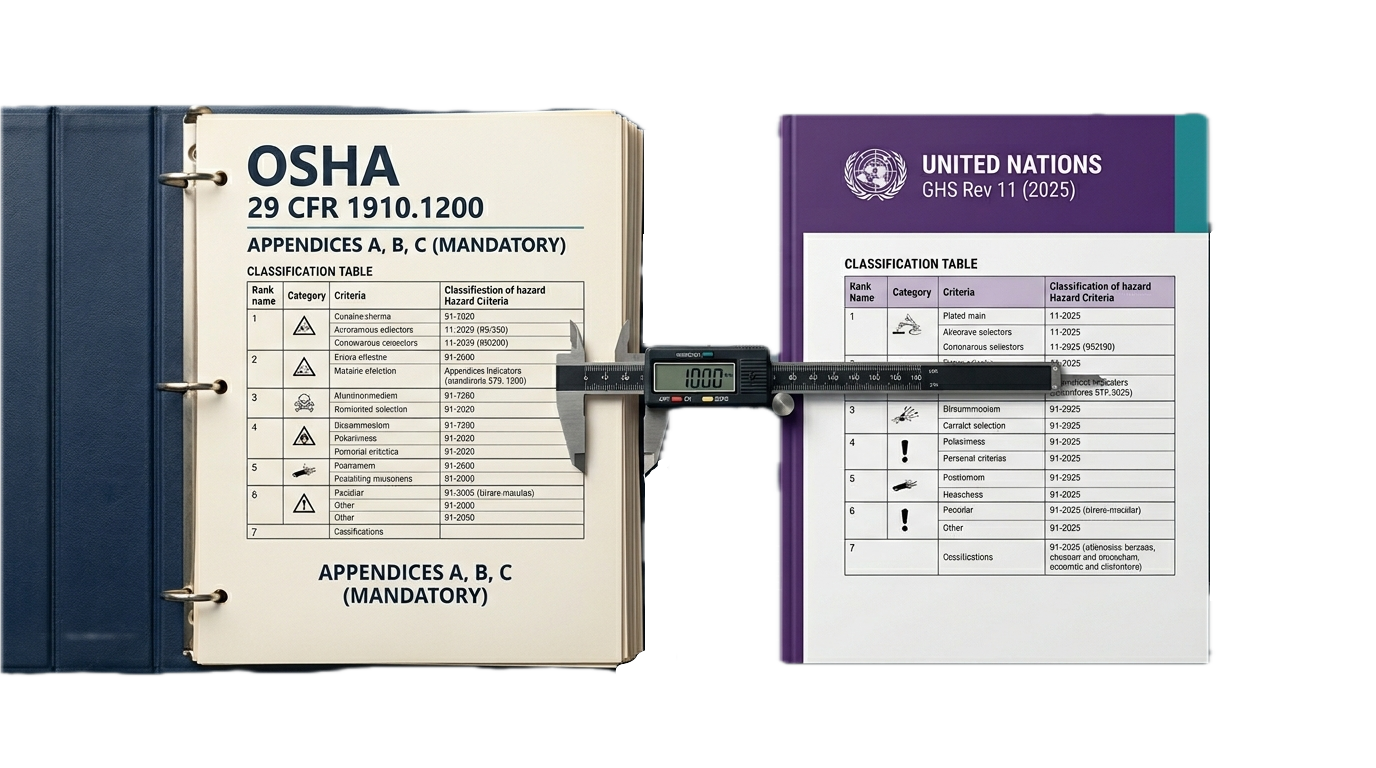
An SDS author who classifies a product straight out of the current UN Purple Book, or who takes a supplier's EU CLP safety data sheet and reformats it into the 16-section US layout, will produce a document that looks compliant and is not. OSHA's Hazard Communication Standard does not incorporate the GHS by reference. It reproduces a specific, frozen subset of GHS criteria in three mandatory appendices to 29 CFR 1910.1200 , and for US compliance those appendices control, not the Purple Book on your shelf. As of the standard now in force they sit at GHS Revision 7 with a handful of Revision 8 additions, while the UN Sub-Committee has published Revision 11 (2025). The space between what Rev. 11 says today and what Appendices A, B, and C require is where most cross-border classification errors live.
This post maps that space: the building blocks OSHA deliberately leaves out, the hazards OSHA adds that the base GHS has never had, the places where the 2024 update closed old gaps, and the EU-specific classes that practitioners routinely mistake for GHS. The point is not to catalog trivia. It is to give you the decision logic for handling a substance or mixture where the US answer and the international answer differ.
01 — AuthorityWhy the appendices control, not the Purple Book
The GHS is built on a "building block" model. The UN publishes a menu of hazard classes, categories, criteria, and label elements, and each jurisdiction selects which blocks to adopt and at what stringency. There is no requirement that an implementing country adopt every category, and the GHS text says so explicitly. OSHA exercised that discretion when it wrote Appendix A (Health Hazard Criteria), Appendix B (Physical Hazard Criteria), and Appendix C (Allocation of Label Elements), each designated mandatory. The standard makes those appendices the operative criteria across three provisions: 29 CFR 1910.1200(d)(1) imposes the duty to classify, requiring the manufacturer or importer to determine the hazard classes and, where appropriate, the category of each class that apply; (d)(2) directs that Appendix A is consulted for health hazards and Appendix B for physical hazards; and (d)(3)(i) requires evaluators to follow the procedures described in Appendices A and B. A chemical is classified by applying those appendix criteria, not by reference to the current Purple Book.
The consequence is that OSHA's criteria are static between rulemakings. The UN revises the GHS on a two-year cycle. OSHA revises HazCom roughly once a decade. When the two disagree, the appendix text wins for any product sold or used in a US workplace, even if a newer Purple Book has superseded that text internationally. An author who reaches for the current UNECE recommendation to resolve an edge case is using the wrong authority.
02 — BaselineThe version state as of this rulemaking
OSHA published the HazCom final rule on May 20, 2024 (89 FR 44144) , effective July 19, 2024. It aligns the standard primarily with GHS Revision 7 (2017) and pulls in select elements of Revision 8 (2019), specifically the chemicals-under-pressure hazard class and the non-animal test methods for skin corrosion and irritation. It does not touch Revisions 9, 10, or 11.
Compliance is phased and was then extended. OSHA's January 15, 2026 rule (91 FR 1695) added four months to each deadline. For substances, the classification-and-relabeling deadline moved from January 19, 2026 to May 19, 2026 , which has now passed. For mixtures it moved to November 19, 2027. The corresponding employer deadlines (workplace labeling, written program, training) are November 20, 2026 for substances and May 19, 2028 for mixtures. During the transition window a manufacturer may comply with the 2012 standard, the 2024 standard, or both, but the practical reality for substances is that the 2024 criteria are now the operative ones.
- + Chemicals under pressure (Rev. 8)
- + Non-animal skin corrosion / irritation methods (Rev. 8)
- + US-defined hazards & HNOC backstop
- · Full building-block menu through 2025
- · Low-severity categories OSHA declines
- · Environmental / aquatic classes
So the working baseline today is: OSHA at Rev. 7 plus two Rev. 8 items, the UN at Rev. 11. Four revisions of drift, and the drift is not symmetric. Some of it is OSHA holding back blocks the UN offers. Some of it is OSHA carrying blocks the UN never had.
03 — SubtractionThe building blocks OSHA leaves out
The cleanest example is acute toxicity. The GHS defines five categories by LD50 (oral, dermal) and LC50 (inhalation). OSHA adopts only Categories 1 through 4. Category 5, the low-toxicity catch-all covering an oral or dermal LD50 in the 2000 to 5000 mg/kg range, is not in Appendix A.1.
| Route | OSHA adopts (Appendix A.1) | Cat 5GHS only | |||
|---|---|---|---|---|---|
| Cat 1 | Cat 2 | Cat 3 | Cat 4 | ||
| Oral (mg/kg bw) | ≤ 5 | > 5–50 | > 50–300 | > 300–2000 | > 2000–5000 |
| Dermal (mg/kg bw) | ≤ 50 | > 50–200 | > 200–1000 | > 1000–2000 | > 2000–5000 |
| Inhalation — gases (ppmV) | ≤ 100 | > 100–500 | > 500–2500 | > 2500–20000 | — |
| Inhalation — vapors (mg/L) | ≤ 0.5 | > 0.5–2.0 | > 2.0–10.0 | > 10.0–20.0 | — |
| Inhalation — dusts/mists (mg/L) | ≤ 0.05 | > 0.05–0.5 | > 0.5–1.0 | > 1.0–5.0 | — |
The regulatory logic behind the omission is that OSHA judged Category 5 to add labeling without meaningfully improving worker protection, and it had no analog in Rev. 3 when the 2012 rule was written. The practical effect shows up in two places. First, a substance with an oral LD50 of, say, 3500 mg/kg carries no acute-toxicity classification on a US SDS but would carry Category 5 (H303) on a Rev. 7-or-later international SDS. Second, the mixture calculation changes. Appendix A.1 supplies converted acute toxicity point estimates used in the additive ATE formula —
100 / ATEmix = Σ ( Ci / ATEi )
— and the converted values OSHA recognizes stop at Category 4 (oral 500, dermal 1100, gas 4500 ppmV, vapor 11 mg/L, dust/mist 1.5 mg/L). There is no Category 5 point estimate to feed in. A 2000 to 5000 mg/kg ingredient that the GHS would fold into the mixture calculation as a weak contributor is, under OSHA, simply not an acute-toxicity ingredient.
The same pattern repeats across other endpoints. Skin corrosion/irritation under GHS Chapter 3.2 runs Category 1 (corrosive), Category 2 (irritant), and Category 3 (mild irritant). OSHA adopts 1 and 2 and omits Category 3. Aspiration hazard under Chapter 3.10 has Categories 1 and 2; OSHA's Appendix A.10 adopts only Category 1. In each case the omitted block is the lowest-severity tier, and in each case the reasoning is the same: OSHA decided the marginal communication value did not justify the burden.
Environmental hazards are a category unto themselves. The GHS classes "Hazardous to the Aquatic Environment" (Chapter 4.1, Acute Category 1 and Chronic Categories 1 through 4) and "Hazardous to the Ozone Layer" are outside OSHA's statutory jurisdiction, which is worker safety, not environmental protection. OSHA does not require you to classify a product for aquatic toxicity. SDS Sections 12 through 15 must physically appear on the sheet because Appendix D mandates the 16-section format, but OSHA has stated it will not enforce their content. This is the single biggest source of confusion when reconciling a US SDS against an ECHA-driven EU sheet, because the EU treats aquatic classification as mandatory and the environmental hazard pictogram (the dead fish and tree) is a common sight on European labels and a non-element under HazCom.
An omitted building block does not create a license to suppress hazard information. It changes how the hazard is communicated, not whether it is.
04 — The backstopThe HNOC backstop, and why "not classified" is not "not hazardous"
OSHA anticipated exactly the gap that omitted blocks create and built a catch mechanism into the definition of hazardous chemical in 1910.1200(c). . The term "hazard not otherwise classified" (HNOC) means an adverse physical or health effect identified through the weight-of-evidence classification process that does not meet the criteria of any adopted hazard class. The definition then says the quiet part out loud: this includes an effect that falls below the cut-off of an adopted class, or that sits in "a GHS hazard category that has not been adopted by OSHA (e.g., acute toxicity Category 5)."
That parenthetical is the rule. If your classification turns up evidence of an adverse effect, and the only GHS home for it is a category OSHA didn't adopt, you do not get to drop it. You disclose it as an HNOC in Section 2 of the SDS. The substance becomes a "hazardous chemical" by virtue of the HNOC alone, which means it carries full HazCom obligations: SDS, training, and inclusion in the written program. HNOC does not carry a standardized GHS pictogram or signal word, and it is not required on the shipped-container label as a GHS element, though it may appear as supplementary information. The communication path is the SDS.
"No OSHA category" is not "no hazard." It is a different communication path — through the SDS, as an HNOC.
Treating "OSHA doesn't have this category" as "this isn't a HazCom hazard." For Category 5 acute toxicity, skin irritation Category 3, and aspiration Category 2, evaluate whether the underlying effect rises to an HNOC and disclose accordingly. Authors who mechanically map an EU table to OSHA categories and delete anything without a US match are under-disclosing.
05 — AdditionThe hazards OSHA adds that the GHS never had
Drift runs the other direction too. To avoid reducing worker protections that predated the 2012 alignment, OSHA carries hazard concepts the base GHS does not recognize. The definition of hazardous chemical in 1910.1200(c). names them: a chemical classified as a physical or health hazard, "a simple asphyxiant, combustible dust, pyrophoric gas, or hazard not otherwise classified."
Simple asphyxiants are substances that displace oxygen in ambient air and can cause oxygen deprivation, unconsciousness, and death. There is no GHS class for this; nitrogen, argon, and similar gases are not "toxic" by any GHS endpoint, but they kill in confined spaces. OSHA assigns them the signal word "Warning" and a specified hazard statement, with no pictogram. Combustible dust is finely divided solid particulate that poses a flash-fire or explosion hazard when dispersed. Again no GHS analog, again a US-defined hazard with a signal word and statement but no pictogram. Both must be addressed in SDS Section 2 and on the label per Appendix C.
Pyrophoric gases tell a more interesting story, because they show the gap closing. OSHA added pyrophoric gas as a defined term in 2012 because Rev. 3 had no criteria for it. The UN then created criteria in Rev. 6, folding pyrophoric and chemically unstable gases into the flammable gases class. The 2024 rule adopts the Rev. 7 treatment: Category 1 flammable gas is now subdivided into 1A and 1B, with pyrophoric gases and chemically unstable gases classified as Category 1A. The standalone "pyrophoric gas" definition has effectively migrated into the flammable gas class. If you are still treating pyrophoric gas as an OSHA-only bolt-on, update that mental model; under the current standard it is Flammable Gas Category 1A.
06 — ConvergenceWhere the 2024 update narrowed the gap
The 2024 rule was a convergence exercise, and several long-standing US divergences disappeared. Besides the flammable gas 1A/1B split, the rule renamed "Flammable Aerosols" to "Aerosols" and added Category 3 for non-flammable aerosols, matching the Rev. 7 structure (flammable aerosols remain Category 1 or 2). It added desensitized explosives as a new physical hazard class with Categories 1 through 4, based on corrected burning rate, for explosives wetted, diluted, dissolved, or suspended to suppress their explosive properties. And it pulled the chemicals-under-pressure class (Categories 1 through 3) from Rev. 8.
The lesson for anyone maintaining a classification engine or an SDS library is that "OSHA equals Rev. 7" is a useful first approximation but not a literal one. The standard is Rev. 7, minus the blocks OSHA still declines (acute tox 5, skin irritation 3, aspiration 2, environmental), plus the US-defined hazards (simple asphyxiant, combustible dust, HNOC), plus the two Rev. 8 items it chose to import. You cannot regenerate an OSHA classification by running a clean Rev. 7 ruleset, and you certainly cannot by running Rev. 11.
07 — False friendsThe EU CLP classes that are not GHS at all
A specific and growing confusion deserves its own treatment. Practitioners increasingly encounter EU safety data sheets carrying hazard classes for endocrine disruption (for human health and for the environment), and for persistence and bioaccumulation: PBT, vPvB, and the newer mobility-based classes PMT and vPvM. These were added to the EU CLP Regulation by Delegated Regulation (EU) 2023/707. They are not in the UN GHS. The UN Sub-Committee has discussed such hazards but has not adopted them into the Purple Book through Rev. 11. They are therefore neither GHS nor OSHA.
This matters in two directions. First, do not assume that because a class appears on a European SDS it belongs in the GHS canon or has any US analog; it may be a unilateral EU addition. Second, do not import an EU-specific class onto a US SDS as a classified hazard with a signal word and pictogram, because OSHA has no criteria for it and Appendix C allocates no label elements to it. If the underlying data shows a genuine adverse human-health effect, the HNOC route is available; otherwise it is environmental information that lives, unenforced by OSHA, in Section 12. Treating EU CLP as if it were GHS, and GHS as if it were OSHA, are two distinct errors that compound when a single product moves across both regimes.
08 — ProcedureLabel allocation and procedural divergences
Appendix C is mandatory and it is where classification turns into label text. Two divergences from base GHS recur in practice. The OSHA-defined hazards (simple asphyxiant, combustible dust) get OSHA-specified signal words and hazard statements with no pictogram, an allocation that exists nowhere in the Purple Book. HNOC carries no standardized label elements and is communicated through the SDS, optionally as supplementary label information.
Two procedural features of the US standard also have no clean GHS parallel and trip up authors focused only on classification criteria. The "released for shipment" provision ties label currency to the date a container is released for shipment; when significant new hazard information becomes available, the standard allows six months to update labels on newly released containers, and containers already in commerce do not require relabeling. And the trade-secret provisions now require that when an exact concentration is withheld, the SDS disclose the concentration range the value falls within, using a prescribed set of narrow ranges adapted from Health Canada's Hazardous Products Regulations. Neither is a hazard-criteria difference, but both are places where an SDS built to a generic GHS template will be non-conforming in the US.
09 — Decision logicDecision rules
When the US answer and the international answer diverge, work from these.
For any US-destined SDS or label, classify against the text of Appendices A, B, and C as currently in force. Do not resolve edge cases against the current UN Purple Book. The appendix text is the authority and it is frozen at Rev. 7 plus the chemicals-under-pressure class and non-animal skin methods from Rev. 8.
When an endpoint lands in a GHS category OSHA did not adopt (acute toxicity Category 5, skin irritation Category 3, aspiration Category 2), do not delete the hazard. Evaluate it as a candidate HNOC under 1910.1200(c). and, if the weight of evidence supports an adverse effect, disclose it in SDS Section 2. "No OSHA category" is not "no hazard."
Do not classify products for aquatic or other environmental hazards to satisfy OSHA; it is outside OSHA's jurisdiction and unenforced. Keep the information in Sections 12 through 15, which must appear but whose content OSHA will not cite. Do not let an environmental classification stand in for a required health or physical classification.
Treat pyrophoric and chemically unstable gases as Flammable Gas Category 1A, not as a standalone OSHA-only hazard. The 2024 rule absorbed them into the flammable gas class.
When working from a European SDS, separate three layers before transcribing anything: genuine UN GHS classifications that map to OSHA, GHS classifications in blocks OSHA omits (which become HNOC candidates), and EU-only classes such as endocrine disruptor, PBT, vPvB, PMT, and vPvM from Delegated Regulation (EU) 2023/707, which are neither GHS nor OSHA and must not be carried onto a US label as classified hazards.
Do not assume a clean Rev. 7 or Rev. 11 ruleset reproduces an OSHA classification. The operative US ruleset is Rev. 7, minus the omitted low-severity blocks, minus environmental classes, plus the US-defined hazards and HNOC, plus two named Rev. 8 imports. Build or validate classification logic against that exact composition.
Written by the Chemply Regulatory Team. Citations refer to 29 CFR 1910.1200 and its appendices, the May 20, 2024 HazCom final rule (89 FR 44144), the January 15, 2026 deadline-extension rule (91 FR 1695), the UN GHS through Revision 11 (2025), and EU Delegated Regulation (EU) 2023/707.
This is general regulatory information, not legal advice, and it is not a substitute for professional regulatory judgment on a specific product.