
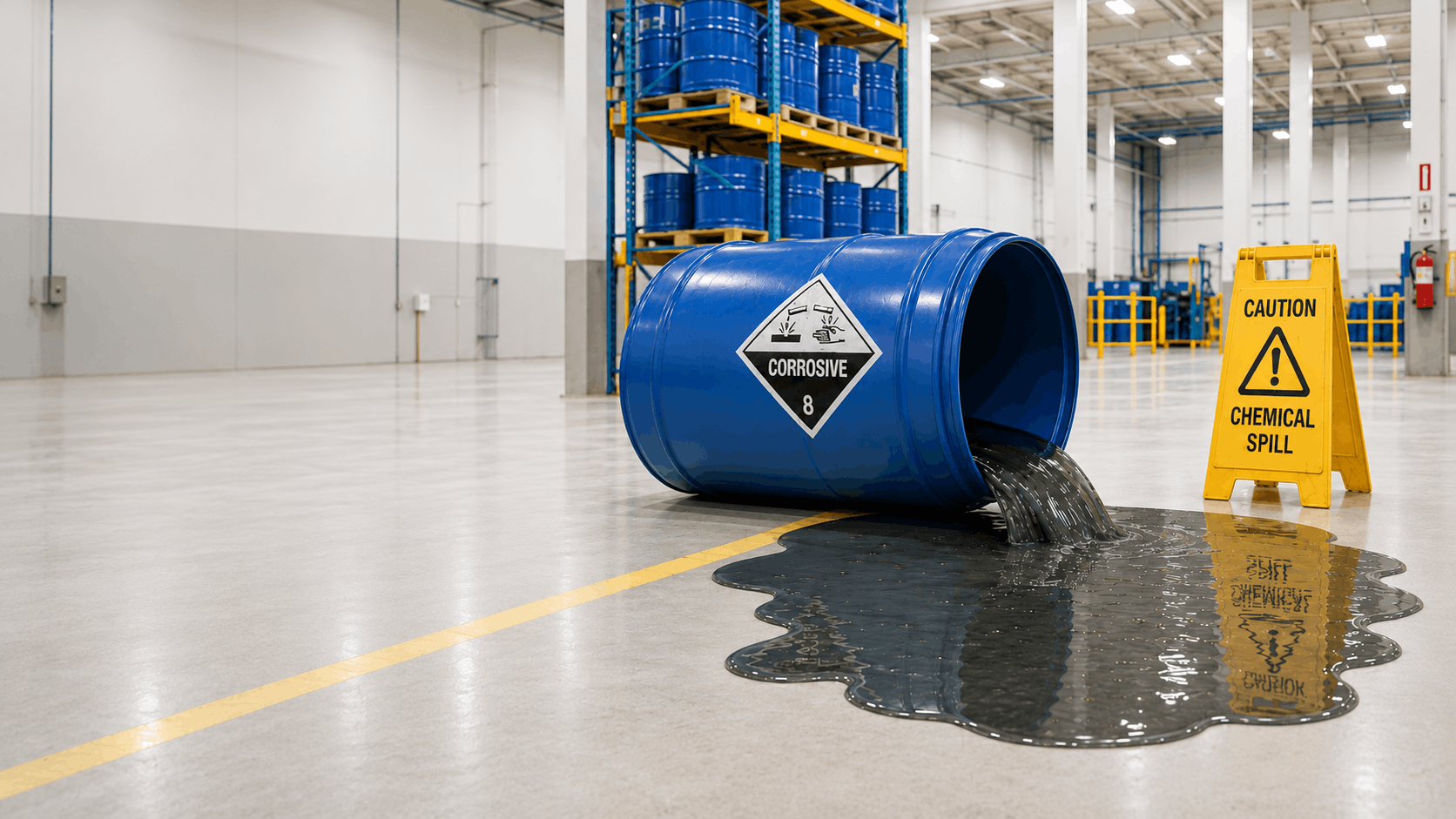
For exposure, go to Section 4: first aid; for a spill, Section 6: accidental release; for fire, Section 5: firefighting. Section 1 provides the supplier's emergency contact. Follow your site's emergency procedures and obtain trained help; locating an SDS should not delay raising the alarm.
A safety data sheet is a sixteen-section document, and when a container tips over or someone gets a chemical in their eyes, very little of it matters. The information that helps in those first minutes is concentrated in three or four sections, and the rest can wait.
The problem most people run into is not that the sheet lacks an answer; it is that they try to read the whole thing front to back while the situation is still developing. Knowing which section answers which question turns a dense ten-page document into a quick reference. This is a guide to where to look, and in what order, depending on what has actually happened.
01 - LayoutEvery sheet has the same layout
The single most useful fact about a safety data sheet is that its structure is fixed. Under OSHA's Hazard Communication Standard, the format is set by Appendix D to 29 CFR 1910.1200, which lists sixteen numbered sections that appear in the same order on every compliant sheet. Section 4 is always first aid. Section 6 is always accidental release. A sheet from one supplier and a sheet from another will not read identically, but the section numbers point to the same kind of information every time. The only flexibility the rule allows is in how information is arranged within a section, not in the order of the sections themselves.
That consistency is what makes the document usable under pressure. There is no need to search; the section number is the index.
Employers must keep SDSs readily accessible during each work shift for employees in their work areas under 29 CFR 1910.1200(g)(8). OSHA has also stated in a letter of interpretation that needing to ask a supervisor for an SDS is itself a barrier to access.
If the sheets in a given area are locked away or only a manager has them, that is worth raising before an emergency rather than during one.
02 - OrientationStart with a quick orientation: Section 2
Before deciding what to do, it helps to know what the chemical actually is. Section 2, Hazard Identification, is the fastest read on the sheet. It carries the signal word, either "Danger" or "Warning"; the hazard statements describing what the chemical can do; the GHS pictograms assigned to its classifications; and the precautionary statements.
A few seconds here answers the basic question of whether the material is corrosive, flammable, toxic, or some combination, which in turn determines which of the next sections is relevant.
Section 2 is orientation, not instruction. It says what kind of trouble the chemical can cause; the later sections say what to do about it.
03 - ExposureIf a person was exposed: Section 4
Section 4, First Aid Measures, is the part of the sheet written for the person standing next to someone who has just been splashed, has inhaled a vapor, or has swallowed something. It is organized by route of exposure, so it separates what to do for inhalation, for skin contact, for eye contact, and for ingestion. Finding the matching route is usually faster than reading the whole section.
Section 4 also lists the most important symptoms to expect, both immediate and delayed, and it indicates when professional medical attention is needed. That last point matters: the first-aid steps on a sheet are meant to stabilize a situation until trained help arrives, not to substitute for it. A note about immediate medical attention is a signal to call for help in parallel with giving first aid, not afterward.
04 - ReleaseIf something spilled or leaked: Section 6
Section 6, Accidental Release Measures, covers a release where nothing is on fire. It has two parts. The first describes personal precautions: what protective equipment is appropriate, how to keep people away from the area, and the basic procedures for approaching the spill safely. The second describes how to contain and clean up the material, including what to absorb it with and what to avoid.
The personal-precautions part is the one that matters first. A spill that looks small can still produce vapor or react with water, and Section 6 indicates when keeping a distance and ventilating the area is the right response rather than reaching for a mop.
Cleanup beyond what a person is trained and equipped for belongs to whoever holds that role at the facility. The sheet describes the method; it does not authorize an untrained worker to carry it out.
05 - FireIf there is fire or a risk of ignition: Section 5
Section 5, Fire-Fighting Measures, is relevant whenever a flammable material is involved or a spill sits near an ignition source. Its most practically useful line is the one identifying suitable and unsuitable extinguishing media, because using the wrong extinguisher can make a fire worse. Water on a fire involving a water-reactive chemical, for example, is a known way to escalate an incident, and Section 5 is where that is flagged.
The section also notes the hazardous products a chemical can give off when it burns, and the protective equipment firefighters need. For most workers the practical takeaway is narrower: whether a particular extinguisher is the right one, and when the correct response is to leave the area to the fire service rather than attempt to put anything out.
06 - ContactWho to call: Section 1
Section 1, Identification, is where the contact information lives. It carries the product name as it appears on the label, the name and U.S. address and phone number of the manufacturer or responsible party, and an emergency phone number. On many sheets that emergency number is a 24-hour response line such as CHEMTREC; on others it is a number the manufacturer maintains directly.
That emergency line is a resource for the responders and the facility, not a replacement for normal emergency services. A serious exposure or a fire still warrants the site's own emergency procedures and, where appropriate, a call to 911. The Section 1 number is the place to reach someone who knows the specific chemical, which is valuable once the immediate response is already underway.
07 - LimitsWhat the sheet does not do
A safety data sheet supports a trained response; it does not create one. Two limits are worth keeping in mind. First, the sheet assumes the reader already knows the facility's emergency plan, evacuation routes, and who is authorized to handle a cleanup. It fills in chemical-specific detail; it does not set the overall plan.
Second, the level of response a sheet describes sometimes exceeds what any single worker should attempt alone. Section 6 describing a containment method is not, by itself, an instruction for one person to carry it out without the right equipment or backup.
The other common difficulty is timing. A sheet read for the first time during an emergency is far slower to use than one a person has seen before. Glancing at the sheets for the chemicals in a given work area ahead of time, so that the layout is familiar, is most of what makes them useful when something goes wrong.
08 - MomentA short reference for the moment it happens
It gives a fast read on what the chemical is and what it can do. It orients the response; it does not direct it.
A person who has been exposed is the priority. Section 4 holds the first aid by route: breathing it in, skin, eyes, or swallowing.
Personal precautions come before any cleanup method, especially where vapor, reactivity, or missing PPE may be involved.
Check which extinguisher is and is not safe to use, and when the right answer is to leave the area.
The manufacturer or emergency response line is useful alongside the facility's own emergency procedures, not in place of them.
SDSs must be accessible in the work area on every shift. Knowing where they are and what the layout looks like matters most before something happens.
Prepare before the incident with the supplier SDS data-gap workflow, the SDS Section 2 hazard checklist, and the international chemical shipping checklist.
This article is general regulatory and workplace-safety information for SDS use during spills, exposures, and related incidents. It is not legal, medical, or emergency-response advice. Follow the site's emergency procedures, product-specific SDS instructions, and directions from trained responders.