
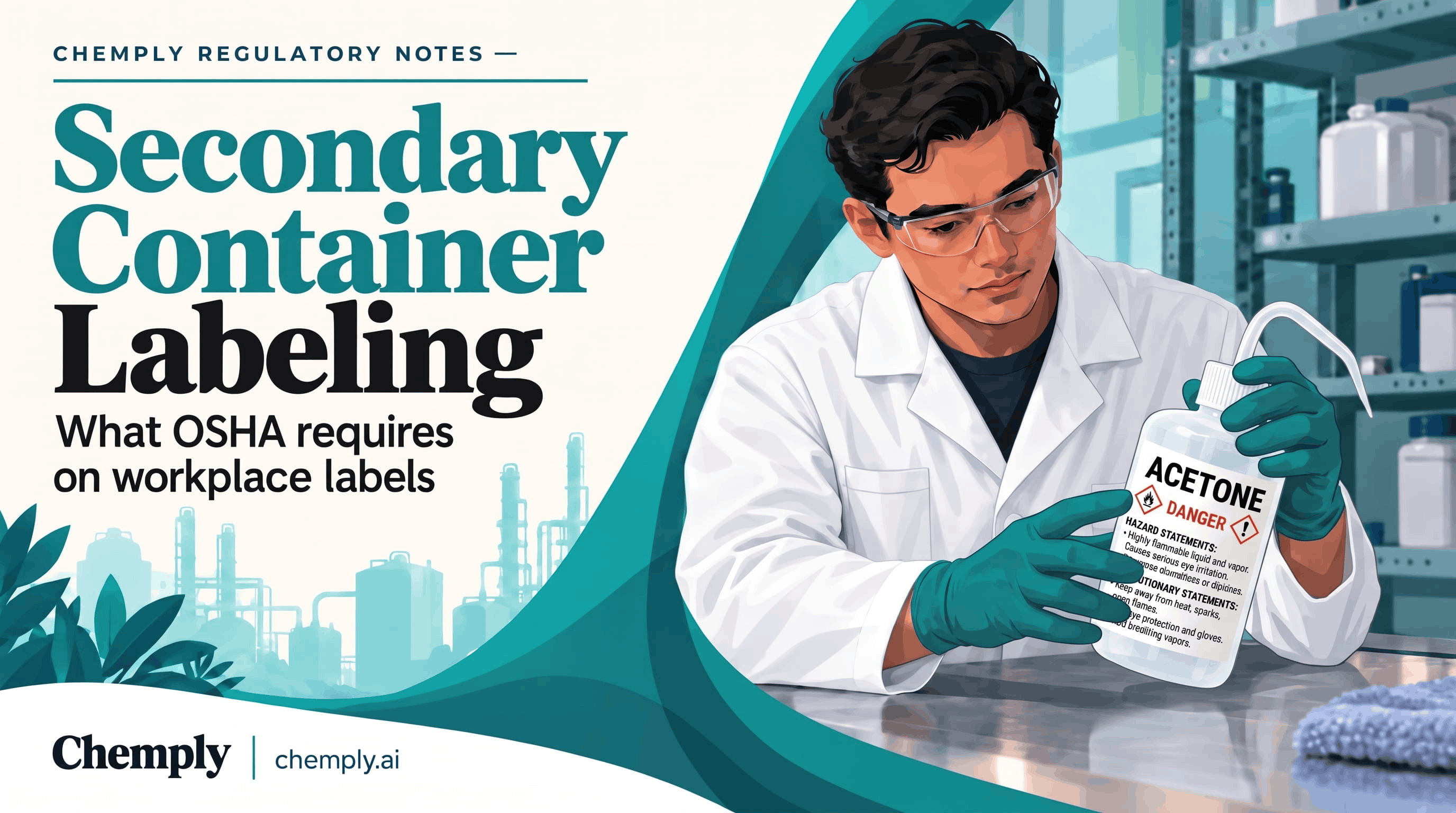
Secondary container labeling under OSHA's Hazard Communication Standard is governed by 29 CFR 1910.1200(f)(6): every container of a hazardous chemical in the workplace must carry either the full shipped-container label information or, at minimum, the product identifier plus words, pictures, or symbols giving general hazard information. The only container-level exemptions are the portable container used immediately by the person who filled it, and stationary process containers identified by signs or batch tickets.
Most findings in this area are not about exotic chemicals. They are spray bottles with a marker-pen product name and nothing else, a crew-shared jug filled on day shift and still in use on nights, a rating diamond that says nothing about a carcinogen, and workplace labels that still reflect a supplier classification that changed months ago. That last point now has a date attached: November 20, 2026 is the employer deadline for updating alternative workplace labeling for newly identified substance hazards under HazCom 2024.
A secondary container label needs, at minimum, the product identifier and general information on all of the chemical's hazards. No label is required only for a portable container filled from a labeled container and used solely by the person who filled it within the same shift, or for a stationary process container covered by an alternative written method under (f)(7). Source: 29 CFR 1910.1200(f)(6)–(f)(8).
01 - RequirementsWhat must a secondary container label include?
Paragraph (f)(6) gives employers a choice of two formats. Both are compliant. Nothing in (f)(6) requires a single format plant-wide, but (h)(3)(iv) requires training on whatever workplace labeling system is used.
| Element | Option 1: full label, (f)(6)(i) | Option 2: workplace label, (f)(6)(ii) |
|---|---|---|
| Product identifier | Required, per (f)(1)(i) | Required |
| Hazard information | Signal word, hazard statements, pictograms, and precautionary statements per Appendix C, (f)(1)(ii)–(v) | Words, pictures, symbols, or a combination giving at least general information on the hazards |
| Pictograms | Required per Appendix C | Not required; if used, a black border is acceptable on in-house labels only |
| Supplier name, US address, and phone | Not required; (f)(6)(i) references (f)(1)(i)–(v) only, not (f)(1)(vi) | Not required |
| Specific hazard information | On the label | Through the label combined with other information immediately available under the HazCom program, plus training |
| Language and legibility | Legible, in English, prominently displayed on the container or readily available in the work area throughout each shift; other languages may be added, (f)(10) | |
Option 1 is the simplest to defend: copy the shipped-container label elements onto the secondary container. Option 2 is lighter on the container but heavier on the program. OSHA's HazCom enforcement directive, reissued for HCS 2024 as CPL 02-02-079 (effective May 19, 2026), restates a burden that dates to the 1994 rule (59 FR 6156): an employer relying on an alternative labeling system instead of labels with complete health-effects information must show, in any enforcement action, that it achieved employee awareness equal to or better than full labels would have produced.
The product identifier is not a free-text field either. The definition in 1910.1200(c) requires the identifier to permit cross-reference among the chemical inventory in the written program, the label, and the SDS. A bottle marked "degreaser" in a plant that stocks three degreasers fails that test even if the hazard words are right. The directive instructs compliance officers to check that the identifier can be cross-referenced to both the SDS and the inventory list.
"General information" means all of the hazards, not the most visible one. A label that says "Flammable" for a solvent that is also a Category 1B carcinogen is incomplete. The directive states that workplace labels must give general information on all hazards of the chemical, and that a label missing required information is not compliant.
02 - ExemptionsWhen are secondary container labels not required?
Secondary container labels are not required in a short list of situations, and the list is shorter than plant practice often assumes. The regulatory text supports these cases and no others.
| Situation | Container label needed? | Basis |
|---|---|---|
| Portable container filled from a labeled container, used only by the person who filled it, within the same shift | No | (f)(8) and the "immediate use" definition in (c) |
| Same container, but handed to a coworker or kept for the next shift | Yes | Outside "immediate use"; (f)(6) applies |
| Stationary process container (for example a permanent dip tank or mixing vessel) | No individual label if signs, placards, process sheets, batch tickets, or operating procedures identify it and convey the (f)(6) information | (f)(7); written materials must be readily accessible throughout each shift |
| Storage tank, including one connected to a distribution system | Yes | Not a stationary process container under the directive's definition |
| Pipes and piping systems | No container label under HazCom | Excluded from "container" in (c); the written program must still cover unlabeled pipes under (e)(1)(ii) |
| Consumer product used as the manufacturer intended, with exposure no greater than a consumer's | No; the product is outside HazCom entirely, so (f)(6) never attaches | (b)(6)(ix); the employer must be able to show both conditions |
| Research laboratory covered by 29 CFR 1910.1450 | No specific secondary-container rule; incoming labels must not be defaced | Laboratory standard; OSHA's 2015 interpretation points to non-mandatory Appendix A recommendations |
The stationary process container exemption is easy to over-apply. The directive defines the term as a container that is not mobile, in which a process other than storage takes place, or which holds a liquid other than water (for example, for dipping and coating). It names permanent dip tanks and permanent mixing vessels as examples and expressly excludes storage tanks and portable dip tanks. If the vessel only stores product, the batch ticket route is not available. The directive also says that labeling portable containers as though they were stationary process containers will be cited under (f)(6)(ii).
The pipe exclusion moves the duty rather than removing it. Paragraph (e)(1)(ii) requires the written program to describe how employees will be informed of the hazards of chemicals in unlabeled pipes in their work areas.
03 - Portable containersWhat counts as "immediate use" of a portable container?
Paragraph (f)(8) exempts portable containers into which hazardous chemicals are transferred from labeled containers and which are intended only for the immediate use of the employee who performs the transfer. The definition of "immediate use" in 1910.1200(c) sets three conditions, all of which must hold: the chemical stays under the control of the person who transferred it, it is used only by that person, and it is used only within the work shift in which it was transferred.
The exemption also requires that the source container was labeled. Filling a bottle from a drum whose label has been painted over or torn off does not qualify, and the defaced drum is its own problem under (f)(9), which prohibits removing or defacing incoming labels unless the container is immediately re-marked with the required information.
The cases that most often fall outside the exemption:
- The shared spray bottle. A maintenance technician fills it, then leaves it on a cart for the crew. Once a second person can use it, the "used only by" condition fails.
- The carry-over container. A bucket of diluted cleaner filled at 2:00 p.m. on first shift and still in the work area at shift change. The "within the work shift" condition fails, and a label is due before that shift ends.
- The unattended container. A filled container left in a common area while the person who filled it goes elsewhere is no longer clearly under that person's control.
- The quality control sample. The directive treats a plant QC sample as exempt only if the person who draws it also performs the analysis. A sample handed off to a lab technician needs a label, and a hand-written label is acceptable if the required information is present.
The practical consequence: a reusable spray bottle or wash bottle that will outlive one shift or one user should be labeled when it is put into service. Relying on the portable container exemption for those items means the exemption has to be re-established every time the container is filled.
The portable container exemption is a property of how a container is used on a given shift, not a property of the container.
04 - Rating systemsCan you use NFPA or HMIS labels on secondary containers?
Yes, as part of an (f)(6)(ii) system, with conditions that the 2026 directive states plainly. NFPA 704 and HMIS ratings may be used if they are applied according to their own guidelines and do not cast doubt on or contradict the hazard information. Employees must be trained to understand what the ratings mean, and compliance officers are told to confirm through employee interviews that workers can connect the codes to the hazards.
Two limits matter. First, the numbering runs the opposite way from HazCom categories: an NFPA rating of 1 means low hazard, while a HazCom Category 1 is the most severe category in its class. Training that does not address that inversion invites misreading. Second, rating systems do not cover every hazard. The directive gives chronic health hazards as the example: if the rating system does not convey a hazard such as carcinogenicity or reproductive toxicity, the label must add words, pictures, or symbols for it. A diamond on its own, with no product identifier and no chronic-hazard information, is not a compliant workplace label.
OSHA's 2017 interpretation to Pinnacol Assurance reached the same structural result for pre-printed secondary container labels that combined a chemical name, an NFPA diamond, and pictograms without hazard statements or manufacturer details: (f)(6)(ii) does not require the manufacturer's name and address, hazard statements, or precautionary statements.
05 - Pictograms and SDSDo workplace labels need red-bordered pictograms, and can the SDS fill the gap?
Pictograms are optional on an (f)(6)(ii) label. Where they are used, the directive allows a black border on in-house labels only. Appendix C.2.3.1 still requires a red frame on shipped-container labels, so a container that later leaves the workplace needs a compliant (f)(1) label, as covered in the GHS pictogram guide. Whatever symbols an employer chooses must not contradict the GHS pictograms; the directive's example of a violation is using the oxidizer symbol to signify a carcinogen.
The SDS question is subtler. Under (f)(6)(ii), the label plus "other information immediately available to employees under the hazard communication program" must deliver the specific hazard information. The 2017 Pinnacol letter accepted the SDS as one source of that supplementary information, provided SDSs are immediately available in the work area throughout each shift (not, for example, in a locked office). The 2026 directive adds a boundary: "other information immediately available" does not include SDSs used in lieu of labels. Read together, the SDS can supply detail behind a compliant workplace label, but it cannot stand in for the product identifier and general hazard information that must be on the container itself.
That makes the SDS on file part of the workplace labeling system. If the SDS behind a workplace label is stale, the "specific information" leg of (f)(6)(ii) is stale too. The supplier follow-up guide covers what to document when an updated SDS has not arrived.
06 - MovementCan a workplace label travel with the container to another site?
No. Workplace labeling applies only to chemicals used within the workplace, and 1910.1200(c) defines a workplace as an establishment, job site, or project at one geographical location. In a December 3, 2018 interpretation, OSHA said chemicals moved within the same building can stay on (f)(6) labels, but containers moved between company properties are leaving the workplace and must carry (f)(1) shipped-container labels, even when the company's own trained personnel move them in company vehicles.
Shipped-container labels also bring the DOT interface into play under (f)(5), and the Section 2 label-element guide covers the Appendix C allocation those labels depend on.
07 - DeadlinesWhat must employers update by November 20, 2026?
HazCom 2024 (89 FR 44144, May 20, 2024) staggered compliance by chemical type and party, and OSHA extended each date by four months at 91 FR 1695 on January 15, 2026. The employer dates are the ones that reach workplace labels.
| Provision | Who and what | Date |
|---|---|---|
| 1910.1200(j)(2)(i) | Manufacturers, importers, distributors: substances, all modified provisions | May 19, 2026 (passed) |
| 1910.1200(j)(2)(ii) | All employers: update alternative workplace labeling under (f)(6), the HazCom program, and training for newly identified substance hazards, as necessary | November 20, 2026 |
| 1910.1200(j)(3)(i) | Manufacturers, importers, distributors: mixtures, all modified provisions | November 19, 2027 |
| 1910.1200(j)(3)(ii) | All employers: the same workplace label, program, and training updates for newly identified mixture hazards | May 19, 2028 |
The words "as necessary" carry weight. The deadline does not require relabeling every secondary container in the plant. The directive frames it as updating workplace labels where the manufacturer, importer, or distributor changed the classification. The work is a comparison: for each substance in use, did the updated supplier SDS or label add or change a hazard, and does the workplace label (or the rating system and training behind it) still convey it?
"Alternative workplace labeling" in (j)(2)(ii) is OSHA's name for the labels employers use under (f)(6) instead of the full shipped-container label: (f)(6)(ii) workplace labels, rating systems used as part of that system, and (f)(7) signs or batch tickets for stationary process containers. It is not a separate labeling duty triggered by how a product is used. If your containers carry full (f)(6)(i) labels copied from current supplier labels, there is no alternative labeling to update, although the program and training updates in (j)(2)(ii) still apply.
Using a product "other than for its intended purpose" does not trigger alternative workplace labeling. The intended-purpose test belongs to the consumer product exclusion in (b)(6)(ix): a consumer product is outside HazCom only while it is used as the manufacturer intended and exposure stays within what a consumer would experience. Once either condition fails, the product is a hazardous chemical like any other, and its secondary containers need an (f)(6) label unless (f)(7) or (f)(8) applies.
Separately from the transition dates, (f)(11)(i) runs continuously: an employer that becomes newly aware of significant hazard information must revise its labels within six months. The directive applies that clock to workplace labels and gives new information on a shipped-container label as an example of what starts it. The HazCom 2024 transition guide covers the full employer checklist for November 20, including program and training updates.
Containers labeled under older systems. The directive notes that chemicals still labeled under the 1994 standard may be present, and requires training explaining that the absence of pictograms or hazard statements does not mean the hazards are absent. That is a training duty, not permission to leave a workplace label that omits a hazard the current supplier label now shows.
08 - EnforcementHow does OSHA inspect and cite secondary container labels?
The directive tells compliance officers to evaluate the effectiveness of in-house labeling systems through training records, SDS procedures, and employee interviews, and states that labeling citations will generally be issued as serious. It maps the common failures to specific paragraphs:
| Finding | Paragraph cited |
|---|---|
| Workplace container unlabeled, or missing the product identifier or hazard description | (f)(6)(ii) |
| Employer chose the full-label option but left out or misstated shipped-label elements | (f)(6)(i) |
| Portable containers labeled as if they were stationary process containers | (f)(6)(ii) |
| Stationary process container not identified, written method incomplete, or not accessible | (f)(7) |
| Incoming label removed or defaced (including partial covering by paint) without immediate re-marking | (f)(9) |
| In-house label illegible (for example, font too small), only in a non-English language, or not prominently displayed | (f)(10) |
| Workplace label not updated within six months of the employer learning of new hazard information | (f)(11)(i) |
Training is the other half of the inspection. Paragraph (h)(3)(iv) requires training that explains the labels received on shipped containers and the employer's workplace labeling system. An employer can have correctly labeled containers and still fail an interview-based effectiveness review if employees cannot explain what the workplace labels mean. The HazCom training requirements guide covers how those interviews are run and what training must include.
09 - ChecklistSecondary container labeling review checklist
- Inventory the containers. List every secondary, transfer, and in-plant container type by work area, and match each product identifier to the chemical inventory and an SDS on file.
- Choose and document the format. Record in the written program whether each area uses (f)(6)(i) full labels, (f)(6)(ii) workplace labels, a rating system, or (f)(7) process documentation, and who is responsible for labeling.
- Test hazard completeness. For each product, compare the workplace label against Section 2 of the current supplier SDS. Add words or symbols for any hazard the label or rating system does not convey, especially chronic health hazards.
- Reconcile with HazCom 2024 supplier updates. For substances whose supplier SDS changed classification, update workplace labels by November 20, 2026; queue mixtures for the May 19, 2028 employer date or earlier when the supplier update arrives.
- Audit exemption claims. Confirm that every unlabeled portable container meets all three "immediate use" conditions and every unlabeled vessel is a true stationary process container with accessible written materials.
- Check legibility and language. Confirm labels are readable without aids other than corrective lenses, in English, and durable for the container's service conditions.
- Close the training loop. Confirm employees can explain the workplace labeling system, including any rating scale and the meaning of black-bordered pictograms, and record that training.
10 - DecisionsDecision rules for secondary container labels
Default to a label. If a container holds a hazardous chemical in the workplace, assume (f)(6) applies until a specific exemption is established for that use.
Treat "immediate use" as three tests. Same person in control, same person using, same shift. Failing any one requires a label.
Cover every hazard, not just the rated ones. NFPA or HMIS ratings need supplementary words or symbols for hazards they do not express, and must never contradict the supplier classification.
Use the SDS behind the label, never instead of it. The container must carry the product identifier and general hazard information; the SDS supplies the detail and must be accessible all shift.
Relabel to (f)(1) when a container leaves the site. Workplace labels, including black-bordered pictograms, are valid only within one workplace.
Let supplier changes drive relabeling. A changed classification on a supplier SDS or label starts the update: by November 20, 2026 for HazCom 2024 substance changes, and within six months under (f)(11)(i) for any new significant hazard information.
Prepare the full employer update with the HazCom 2024 November 20 checklist, check symbol meanings in the GHS pictogram guide, and trace shipped-label elements through SDS Section 2.
Primary sources
- 29 CFR 1910.1200, Hazard Communication: (c) definitions, (e)(1), (f)(6)–(f)(11), (h)(3), (j)
- 29 CFR 1910.1200 Appendix C, Allocation of Label Elements
- OSHA Instruction CPL 02-02-079, Inspection Procedures for the Hazard Communication Standard (HCS 2024), effective May 19, 2026
- 91 FR 1695, Hazard Communication Standard compliance date extension, January 15, 2026
- OSHA letter of interpretation, Labeling of Secondary Containers, June 20, 2017
- OSHA letter of interpretation, intra-plant and intercompany shipping, December 3, 2018
- OSHA letter of interpretation, labeling of small containers in the laboratory, September 3, 2015
Written by the Chemply Regulatory Team. Primary sources were checked October 19, 2026.
This is general regulatory information, not legal advice. State Plan states may adopt their own hazard communication rules and enforcement procedures; confirm requirements for your jurisdiction.